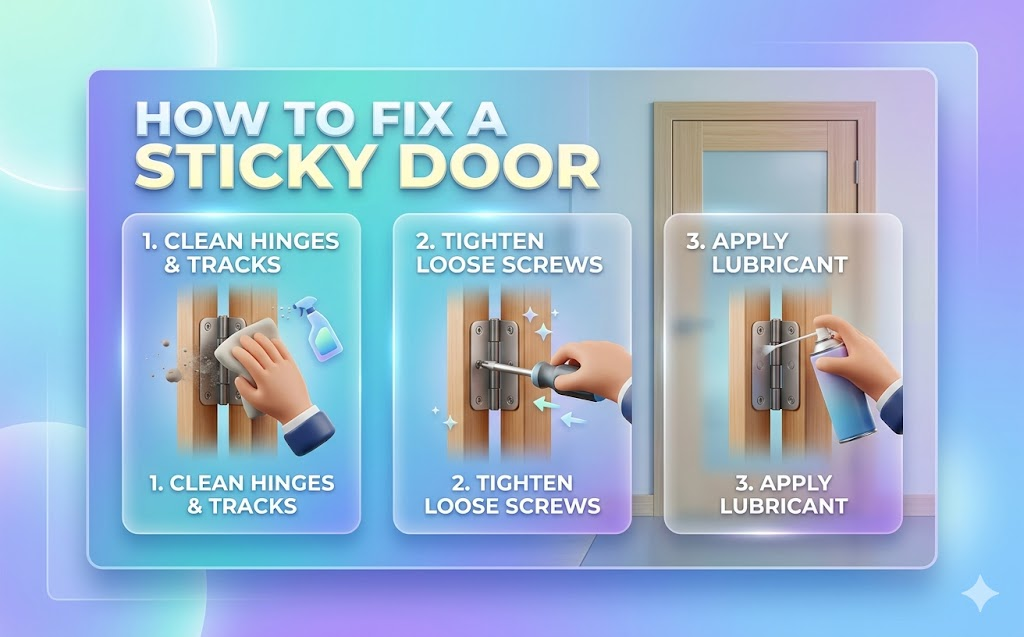
If you’ve ever thrown your shoulder into a door just to get it open, you already know how frustrating a sticky door can be. The good news is that learning how to fix a sticky door doesn’t require a contractor, a big budget, or a full weekend. In most cases, you can pinpoint the exact cause in under a minute and have it fixed in well under an hour.
This guide is built differently from most door repair tutorials. Instead of listing random fixes and hoping one works, we’ll start with a quick diagnostic to identify why your door is sticking, then walk through the exact fix for your situation — by cause, by door type, and by skill level.
Quick Answer: How to Fix a Sticky Door
In most cases, a sticky door is caused by loose hinges, humidity-related wood swelling, or a frame that has shifted slightly out of alignment. Tighten the hinge screws first, since this is the fastest and cheapest fix. If the door still binds, identify the exact rubbing point, sand or plane that area down, then reseal the edge with varnish or paint to prevent future swelling.
That’s the short version. Now let’s get into the diagnostic process so you fix the actual problem instead of guessing.
The 60-Second Sticky Door Diagnostic
Before you grab any tools, take a minute to actually watch and feel where your door is sticking. This single step will save you from sanding the wrong spot or replacing hinges that were never the problem in the first place.
Open and close the door slowly several times and ask yourself these questions:
- Where does it rub? Top corner, bottom corner, the latch side, or all the way around?
- Does the hinge side feel loose when you wiggle the door side to side?
- Has it gotten worse with the seasons — sticking more in summer or winter specifically?
- Did it start sticking right after you painted it?
- Is the latch hard to catch, even if the door itself swings freely?
Use the table below to match your symptom to the likely cause before moving to the fix sections.
| Symptom | Likely Cause | Jump to Fix |
|---|---|---|
| Door sags, top corner rubs frame | Loose or worn hinges | Fix #1 |
| Sticks worse in humid weather | Wood swelling from moisture | Fix #2 |
| Sticks along entire edge, gap uneven | Frame has shifted or warped | Fix #3 |
| Started after a fresh paint job | Excess paint buildup | Fix #4 |
| Latch won’t catch smoothly | Misaligned strike plate | Fix #5 |
| Sticks only at the very bottom | Flooring change or door drop | Fix #6 |
Why Does a Door Stick? The Real Causes Explained
Most articles only mention two or three reasons a door sticks. In reality, there are at least six common causes, and identifying the right one is the difference between a five-minute fix and an afternoon of unnecessary sanding.
Humidity and Wood Swelling
This is the most common cause, especially for solid wood doors. Wood is porous, so it absorbs moisture from the air. When indoor humidity climbs above roughly 60-70%, the door’s edges can swell just enough to bind against the frame. This is why a door can feel perfectly fine in winter and stick badly in summer.
Loose or Worn Hinges
Every time a door opens and closes, a small amount of stress hits the hinge screws. Over months and years, those screws back out slightly, causing the door to sag. A sagging door no longer hangs square in its frame, so the top corner catches.
Foundation or Frame Shifting
As homes settle over time, door frames can shift slightly out of square. This is more common in older homes or houses on certain soil types. Unlike humidity swelling, this kind of sticking tends to be consistent year-round rather than seasonal.
Improper Installation
If a door was hung even slightly out of plumb when it was installed, it may have stuck from day one, or developed a stick as the house settled further. This is more common with interior doors installed during DIY renovations.
Excess Paint or Finish Buildup
Multiple coats of paint, especially if applied without sanding between coats, can add enough thickness to the door’s edge to cause rubbing. This is a very common, often overlooked cause of a freshly painted door suddenly sticking.
Strike Plate Misalignment
Sometimes the door itself swings fine, but it doesn’t sit flush in the frame because the latch and strike plate don’t line up. This can feel like the door is “sticking” even though the actual problem is at the latch, not the door edge.
How to Fix a Sticky Door: Step-by-Step by Cause
Now that you’ve identified your likely cause from the diagnostic table, follow the matching fix below.
Fix #1: Tighten or Replace the Hinges
This is the cheapest and fastest sticky door repair, so it’s worth trying first even if you suspect another cause.
Tools needed: Screwdriver, optional wooden golf tees or toothpicks, wood glue
- Open the door and inspect each hinge for visible gaps between the hinge plate and the frame.
- Tighten every screw, starting with the top hinge since it carries the most weight.
- If a screw spins freely without tightening, the hole is stripped. Remove the screw, dip a wooden toothpick or golf tee in wood glue, insert it into the hole, snap off the excess, and let it dry for an hour.
- Reinsert the screw into the repaired hole and tighten as normal.
Time: 10-15 minutes | Cost: Under $5 | Skill level: Beginner
Fix #2: Sand Down a Swollen Door
If humidity is the culprit, you’ll need to remove a thin layer of material from the swollen area.
Tools needed: Sandpaper or a hand plane (a power sander works but isn’t required), carbon paper, paintbrush, varnish or matching paint
- Tape a sheet of carbon paper, ink-side facing the door, over the area where it sticks.
- Close the door gently against it. The ink transfer will mark the exact binding spot.
- Remove the door from its hinges if the sticking point is along the bottom or hard to reach.
- Sand or plane the marked area gradually, checking your progress often rather than removing too much at once.
- Aim for a slight beveled edge rather than a flat cut — this prevents future rubbing as the door settles back into place.
- Once it swings freely, seal the bare wood edge with two to three thin coats of varnish or matching paint. This step is critical: an unsealed edge will simply absorb moisture again and swell once more.
Time: 1-2 hours | Cost: $15-30 | Skill level: Beginner to intermediate
Fix #3: Address a Shifted or Warped Frame
If the gap between your door and frame is uneven all the way around rather than at one specific spot, the frame itself may have shifted.
- Use a level against the door frame’s vertical sides to check if it’s still plumb.
- Check the frame corners for square using a carpenter’s square.
- Minor shifts can often be corrected by adjusting the hinge-side screws slightly deeper or shallower to re-square the door within the frame.
- Significant warping or a frame that’s visibly out of square may require shimming behind the hinge plates or, in more serious cases, reframing — this is where it’s worth calling a professional.
Time: Varies | Cost: $0-200+ depending on severity | Skill level: Intermediate to professional
Fix #4: Remove Excess Paint Buildup
- Inspect the door edge closely for visible ridges or thick, uneven paint layers.
- Lightly sand the binding area down to a smooth, even surface.
- Wipe away dust with a damp cloth.
- If repainting, apply only one to two thin coats rather than a heavy single coat, and let each coat dry fully before the next.
Time: 30-45 minutes | Cost: $10-20 | Skill level: Beginner
Fix #5: Adjust the Strike Plate
- Close the door slowly and watch exactly where the latch meets the strike plate.
- If they’re misaligned, loosen the strike plate screws slightly.
- Reposition the plate up, down, or sideways by a small amount to match the latch.
- If the misalignment is more than about 1/8 inch, you may need to extend the mortise (the recessed cutout) with a chisel rather than just shifting the plate.
Time: 15-20 minutes | Cost: Under $10 | Skill level: Beginner
Fix #6: Trim the Bottom of the Door
If new flooring, carpet, or a rug was added and now the door drags along the bottom, you’ll need to trim it.
- Remove the door from its hinges for easier handling.
- Mark the area that needs trimming, leaving roughly 1/8 inch of clearance between the door and the floor.
- Use a hand plane or belt sander to remove material gradually.
- Reseal the freshly cut edge with varnish or paint before rehanging.
Time: 1-2 hours | Cost: $15-30 | Skill level: Intermediate
Fixing a Sticky Door by Material Type
Not every door responds to the same repair approach. Here’s how the process shifts depending on what your door is made of.
| Door Material | Special Considerations |
|---|---|
| Solid wood | Most prone to humidity swelling; sands and seals easily |
| Hollow-core wood | Sand very lightly — too much removal can expose the hollow interior |
| Fiberglass | Rarely swells from humidity; sticking is usually hinge or frame related |
| Steel/metal | Cannot be sanded down; fix by adjusting hinges or strike plate only |
| Fire-rated doors | Should not be planed or trimmed without consulting code requirements, since altering the door can void its fire rating |
Preventing a Sticky Door From Coming Back
Fixing the immediate problem is only half the job. A few habits will keep your doors swinging smoothly for years. how to fix a leaky faucet
- Monitor indoor humidity. Keep it between 30-50% using a basic hygrometer, and run a dehumidifier in particularly humid climates or seasons.
- Inspect hinges twice a year. A quick screwdriver check during spring and fall maintenance catches loose screws before they cause sagging.
- Paint at the right time. Avoid painting doors during high-humidity days, and always apply thin coats rather than one thick layer.
- Seal all six sides of a wood door, including the top and bottom edges, not just the visible front and back faces. Unsealed edges are the most common entry point for moisture.
- Use felt or weatherstripping on exterior doors to reduce the temperature and moisture swings that cause repeated swelling.
When to Call a Professional
Most sticky door problems are simple DIY fixes, but a few situations are worth handing off to a contractor or carpenter: how to fix a squeaky floor
- The frame is visibly cracked, splitting, or pulling away from the wall
- You suspect foundation settling, especially if multiple doors and windows throughout the house are sticking simultaneously
- The door won’t latch at all, even after adjusting the strike plate
- You’re dealing with a fire-rated door that needs structural modification
Sticky Door Fix Cost and Time Summary
| Fix | Time | Cost | DIY Friendly |
|---|---|---|---|
| Tighten hinges | 10-15 min | Under $5 | Yes |
| Sand swollen edge | 1-2 hours | $15-30 | Yes |
| Adjust strike plate | 15-20 min | Under $10 | Yes |
| Remove paint buildup | 30-45 min | $10-20 | Yes |
| Trim door bottom | 1-2 hours | $15-30 | Mostly |
| Frame repair | Varies | $0-200+ | Sometimes |
Frequently Asked Questions
Why does my door only stick in the summer?
Summer humidity causes wood to absorb moisture and swell slightly, which is enough to make the door rub against its frame. This usually resolves on its own once humidity drops, but sanding and sealing the edge prevents it from recurring.
Can I fix a sticky door without sanding?
Yes, if the cause is loose hinges or a misaligned strike plate rather than wood swelling. Try tightening hinges and adjusting the strike plate first, since these fixes require no sanding at all.
Why did my door start sticking right after I painted it?
Extra paint thickness on the door’s edge is a common cause, especially with multiple coats. Lightly sanding the binding area down and using thinner coats next time will prevent it from happening again.
How much should I sand off a sticky door?
Remove only a small amount at a time, checking the fit frequently. Most sticky doors only need 1/16 to 1/8 inch removed from the binding area, not a full-edge planing.
Is a sticky door a sign of a bigger problem?
Sometimes. A single sticky door is usually just hinges, humidity, or paint buildup. Multiple doors sticking at once, especially alongside cracks in walls or uneven floors, can indicate foundation settling worth having inspected.
Can I fix a sticky metal door the same way as a wood door?
Not exactly. Metal and fiberglass doors don’t swell from humidity, so sanding isn’t an option. Stick to adjusting the hinges or strike plate instead.
Sticky doors are one of the most common home maintenance annoyances, but as you can see, the fix almost always comes down to identifying the actual cause first. Run through the diagnostic, match your symptom to the right fix, and in most cases you’ll have a smooth, quiet door again in well under an hour.
Conclusion
A sticky door is rarely as complicated as it feels in the moment. Once you slow down and actually diagnose where and why your door is rubbing, the fix is usually quick, cheap, and well within DIY reach. Loose hinges, humidity-driven swelling, paint buildup, a misaligned strike plate, or a slightly shifted frame account for nearly every case — and each one has a clear, specific solution rather than a one-size-fits-all approach.
The biggest mistake homeowners make isn’t lack of skill, it’s skipping the diagnosis and sanding the wrong spot, or replacing hinges that were never the problem. Spend the first 60 seconds identifying the actual cause, and the rest of the repair tends to fall into place.
If you’ve worked through the steps above and your door still binds, or if you’re noticing multiple doors sticking at once, that’s a good signal to bring in a professional rather than keep sanding. But for the vast majority of sticky doors, a screwdriver, a little sandpaper, and twenty minutes of your weekend are all it takes to get your door swinging smoothly again.
