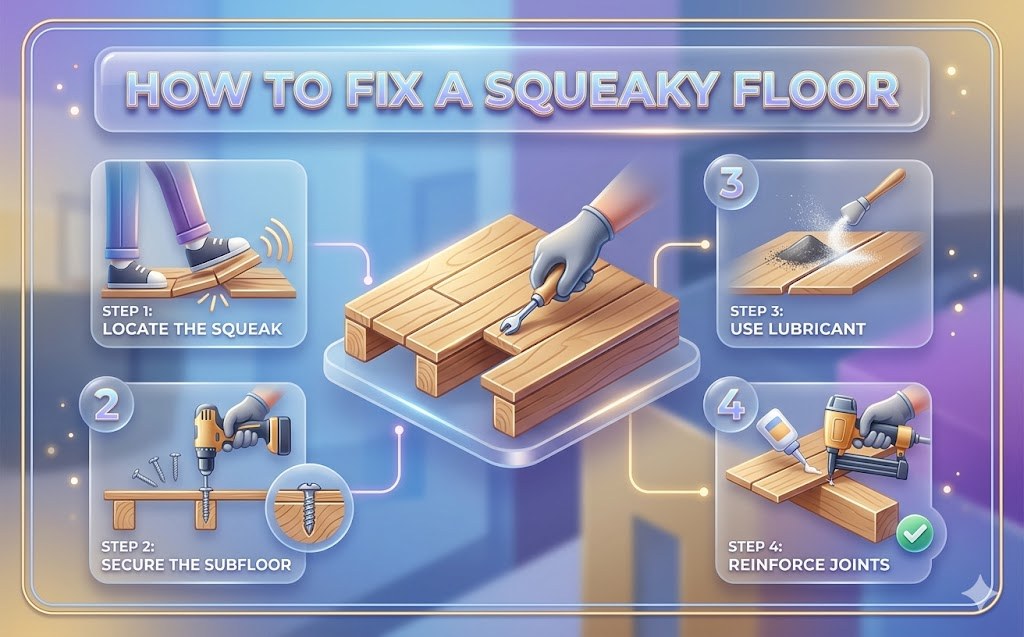
That familiar creak. You know the one — the spot near the hallway, or right outside the bedroom door, that announces your presence every single time. Whether it wakes up your sleeping baby, embarrasses you in front of guests, or simply drives you slowly insane at 2 a.m., a squeaky floor is one of those household problems that feels minor but eats at you every single day.
Here’s the good news: in most cases, you can fix a squeaky floor yourself, without special skills or expensive contractors. But here’s what most guides won’t tell you — the fix depends entirely on what’s actually causing the squeak. Jump straight to a solution without diagnosing the problem, and you’ll waste time, money, and possibly make things worse.
This guide does something different. Before we touch a single screw or shim, we’re going to figure out exactly what’s going on beneath your feet. Then we’ll walk through fixes organized by floor type, access level, and budget — so you get the right solution for your specific situation, not just a generic checklist.
Why Floors Squeak in the First Place
To fix the problem, you need to understand it. A floor squeak is almost always caused by movement — specifically, wood rubbing against something it shouldn’t be rubbing against. That something could be another piece of wood, a nail, a screw, ductwork, or even a pipe.
Your floor is a layered system. From bottom to top, it typically goes: floor joists (horizontal support beams) → subfloor (plywood or particleboard sheets screwed or nailed to the joists) → finished flooring (hardwood, laminate, tile, carpet, etc.). When any layer in that system starts moving independently — because of a gap, a loose fastener, or friction — you get a squeak.
The most common culprits are:
- Gaps between the subfloor and joists — the subfloor lifts slightly away from a joist, and every step causes it to flex down and back up, creating noise
- Loose nails or screws — fasteners back out over time and allow wood to shift
- Wood-on-wood friction — floorboards rubbing against each other at the edges or tongues
- Seasonal expansion and contraction — wood swells in humid summers and shrinks in dry winters, opening and closing tiny gaps
- Improper installation — wrong fastener type, missing expansion gaps, or an uneven subfloor
Understanding which of these is happening in your home is the entire ballgame. That’s why we start with diagnosis.
Step 1 — Diagnose Before You Fix a Squeaky Floor
Most articles skip this part. Don’t. Spending ten minutes diagnosing correctly will save you hours of trial and error.
Is Your Squeak Seasonal?
Walk across the squeaky area right now. Then think back — was it squeaking this time last year? Does it seem worse in winter and better in summer, or vice versa?
If your squeak appears or worsens in dry winter months and fades when humidity returns, you’re likely dealing with seasonal wood contraction. The wood shrinks, gaps open up, and boards have room to move and rub. This type of squeak often resolves partially on its own — and sometimes doesn’t require structural repairs at all, just humidity management.
Test: Run a humidifier in the room for a week. If the squeak noticeably improves, humidity is your primary culprit.
Is It Isolated or Widespread?
Step carefully across the squeaky area and map out how many spots are affected.
- One or two isolated spots — usually a single loose board, a missing nail, or a localized gap between the subfloor and joist. Highly fixable as a DIY project.
- Widespread squeaking across a large area — may indicate a subfloor problem, an uneven or sagging joist system, or a moisture issue affecting the whole floor. May require professional assessment.
What Does the Squeak Sound Like?
The sound itself gives clues.
| Sound Type | Likely Cause |
|---|---|
| Sharp, repetitive creak under direct foot pressure | Board-to-board friction at the tongue and groove joint |
| Low, hollow thud with squeak | Gap between subfloor and joist |
| Squeak only when stepping on one exact plank | Loose individual board |
| Widespread creaking across a whole room | Subfloor movement or seasonal contraction |
| Metal-like squeak | Wood rubbing against a nail or screw |
Red Flags — When to Call a Professional
Before you start any repair, check for these warning signs. If any apply, stop DIYing and call a licensed contractor or structural engineer:
- Floors feel soft, spongy, or springy underfoot
- Visible sagging or dipping across a section of floor
- Cracks appearing at the corners of doors or windows
- Doors or windows that have recently become difficult to open or close
- Water stains on the subfloor or joists visible from below
- Squeaking spread rapidly across a large area in a short time
These signs can indicate foundation movement, joist failure, or water damage — problems that go well beyond a squeaky board and need professional eyes immediately.
Step 2 — Fix by Floor Type
Once you’ve diagnosed the general cause, your floor type determines which fixes are actually available to you. Here’s where most guides fail — they lump every floor together, but laminate, hardwood, and tile all behave differently and require different approaches.
Hardwood Floors
Hardwood is the most common floor type associated with squeaking, and thankfully, it also has the most robust repair options. home soos
Board-to-board friction (most common in hardwood): The tongue of one plank is rubbing against the groove of the adjacent plank. This is usually a quick fix.
- Sprinkle powdered graphite or talcum powder directly into the seam between the squeaky boards
- Work it into the joint with a dry cloth
- Walk back and forth on the boards to push the powder deeper into the crack
- Wipe up excess powder
This is a temporary but often very effective fix. The powder acts as a dry lubricant, reducing friction without damaging the wood or finish. If the squeak returns within a few months, the underlying board movement is too significant for lubrication alone, and you’ll need to secure the board.
Loose individual hardwood plank: If a specific plank is moving up and down (not just side to side), it needs to be fastened down. From above, use trim-head screws, which have a small head that can be countersunk and filled with wood filler tinted to match your floor color. Drill a pilot hole first to avoid splitting the wood, drive the screw into the joist below, countersink it, and fill with color-matched wood filler. how to fix a running toilet
Laminate Floors
Laminate presents a unique challenge: it’s a floating floor, meaning it’s designed to float freely over the subfloor without being fastened down. This means you cannot nail or screw laminate boards to the subfloor — doing so prevents the natural expansion and contraction that keeps the floor intact, and will cause buckling or cracking.
Why laminate squeaks:
- Uneven subfloor causing boards to flex
- Boards installed too tightly against walls (no expansion gap)
- Wrong or missing underlay
- Boards inadvertently pinned down during installation
Fixes for squeaky laminate:
- Check the expansion gap first. Remove baseboard trim around the squeaky section and check if there’s adequate space (typically ⅜ inch) between the flooring edge and the wall. If the floor is butted tightly against the wall, it has no room to move, causing buckling and friction squeaks. Creating expansion space can immediately resolve the problem.
- Powdered graphite or talcum powder worked into the seams between boards reduces friction effectively in laminate, just as in hardwood.
- Replace or add underlay. If the underlay is cheap foam or is missing in spots, the boards have uneven support and will flex. In some cases, if you can lift sections of laminate (which clip together), adding a quality underlay underneath resolves the squeak permanently.
- Address the subfloor. If the subfloor beneath the laminate is uneven, the laminate will flex and creak over the high and low spots. This requires lifting the laminate to access and level the subfloor — a bigger job, but the only permanent solution for subfloor-caused laminate squeaks.
Carpet Over Subfloor
Carpet squeaks are 100% subfloor squeaks — the carpet itself doesn’t squeak. You’re hearing the subfloor moving beneath it.
No-pull-up methods:
- Drive finishing nails directly through the carpet at the squeak location. Use a small-diameter drill bit to create a pilot hole first, then drive a nail straight down. Use as few nails as possible and test after each one.
- Use a stair tool or carpet awl to avoid snagging carpet fibers.
- Powdered graphite can be worked through carpet pile into the seams of the subfloor below, though this is difficult and less effective than other methods.
Pull-up method (more effective): If you’re willing to pull back the carpet (which is less difficult than it sounds — carpet is often just stretched over tack strips at the edges), you get direct access to the subfloor and can use screws, construction adhesive, or shims exactly as you would with an exposed subfloor. Re-stretching the carpet afterward requires a knee-kicker tool, which you can rent cheaply from any home center.
Tile Floors
Tile squeaks are relatively rare, but they do happen — usually when the subfloor beneath the tile is flexing, which can also crack grout lines over time.
- First, check grout lines near the squeak for cracking. Cracked grout around the squeak confirms subfloor movement.
- If you have basement access, fixing the subfloor from below (with shims or blocking) is by far the easiest approach and avoids touching the tile.
- Fixing from above means removing tiles, which risks cracking adjacent tiles and is best left to someone with tile installation experience.
Engineered Wood Floors
Engineered wood is more dimensionally stable than solid hardwood, but it’s not immune to squeaking. The causes are similar — subfloor gaps, loose fasteners, or board-to-board friction.
The key difference: engineered wood can be either glued down, nailed/stapled down, or floated, depending on how it was installed. The fix depends on the installation method:
- Glued down: Powdered lubricant in the seams is your best non-invasive option. Screwing from above is risky since the boards are thin.
- Nailed/stapled down: Trim-head screws from above work well.
- Floating: Treat the same as laminate — check expansion gaps, underlay quality, and subfloor levelness.
Step 3 — Fix by Access Level
Your diagnosis and floor type tell you what to fix. Your access level tells you how to fix it.
Fixing from Below (Best Option When Available)
If the squeaky floor is on the ground level and you have a basement or crawlspace, consider yourself lucky. This is the easiest and most effective approach for subfloor and joist-related squeaks.
What you’ll need:
- Flashlight or drop light
- Wood shims
- Construction adhesive
- 2×8 or 2×4 blocking lumber
- Wood screws
- A helper upstairs
Process:
- Send a helper upstairs to walk slowly across the squeaky area while you watch from below with your light.
- Watch for movement in the subfloor — even a millimeter of flex is visible and will identify the squeak source.
- Mark the spot on the subfloor from below using painter’s tape or a pencil mark.
For a gap between joist and subfloor: Apply a bead of construction adhesive to a wood shim and slide it gently into the gap — glue side up — between the joist and the subfloor. The key word is gently. Do not force the shim or hammer it in, as this widens the gap and creates a new squeak. You want a snug fit, not a forced wedge. Let the adhesive cure for 24 hours before walking on the floor above.
For a subfloor seam that’s moving: Cut a piece of 2×8 blocking to fit snugly between two joists directly beneath the squeaky seam. Apply construction adhesive to the top edge and slide it into position so its top face presses firmly against the underside of the subfloor. Drive screws at an angle through the blocking and into the joists on each end to hold it in place permanently. This eliminates the flex at the seam.
For a longer gap or sagging joist: Cut a 2×4 to run alongside the length of the joist where the gap is. Apply construction adhesive to the face that will press against the subfloor, and screw it to the joist so it presses up into the subfloor, closing the gap and eliminating movement.
Fixing from Above (No Basement Access)
When you can’t get below the floor, you’re working from the top down. This applies to most second-floor squeaks, slab-on-grade homes, and apartments.
Locating the joist from above: Use a stud finder to locate the joist beneath the squeaky board. Joists typically run perpendicular to the floorboards and are spaced either 12 or 16 inches apart. Mark the joist location with painter’s tape — you need to drive your screws into the joist, not just into the subfloor.
Driving screws from above:
- Drill a pilot hole through the finished flooring and subfloor
- Drive a trim-head screw (for hardwood) or finish screw (for carpet) down through the floor and into the joist
- Countersink the screw below the surface of the wood
- Fill the hole with color-matched wood filler or putty
- Sand flush when dry
The screw pulls the subfloor tight against the joist, eliminating the gap and the squeak.
Specialty kits for above-floor repair:
| Product | Best For | How It Works | Approx. Cost |
|---|---|---|---|
| Squeeeek No More Kit | Carpet and hardwood | Screw snaps off below surface flush with floor | $20–$25 |
| Squeak-Ender | Hardwood, basement access | Threaded rod pulls subfloor to joist | $15–$20 |
| Counter-Snap Kit | Hardwood, above access | Scored screws snap below surface cleanly | $20–$25 |
| SPAX T-STAR Screws | Subfloor/structural | 4CUT point, no pre-drilling needed | $10–$20 |
Renter-Safe Fixes (Non-Destructive Methods Only)
If you’re renting, you cannot drill, screw, or modify the floor in any permanent way. Here’s what you can do:
- Powdered graphite or talcum powder worked into the seams between floorboards is completely reversible and leaves no damage. This is your best first-line fix as a renter.
- WD-40 or dry lubricant spray can be carefully applied along the edges of squeaky boards. Avoid using oil-based products on finished hardwood as they can affect the finish — stick to dry graphite powder.
- Area rugs with thick pads won’t fix the squeak but will muffle it significantly in high-traffic areas.
- Talk to your landlord. Document the squeak (a short video works) and submit a maintenance request. Structural squeaks that indicate subfloor issues are the landlord’s legal responsibility in most U.S. states.
- Furniture placement. Heavy furniture like bookshelves placed near (not on) squeaky areas can reduce flex in those boards by adding localized weight to the joist span. This is admittedly a workaround, not a fix — but in a rental, workarounds matter.
Step 4 — Products Compared: What Actually Works
The market is full of squeaky floor solutions. Here’s an honest breakdown so you don’t waste money:
| Method | Permanence | Skill Required | Best For | Cost |
|---|---|---|---|---|
| Talcum / graphite powder | Temporary | None | Hardwood, laminate, renters | $2–$8 |
| WD-40 / dry lubricant | Temporary | None | Renters, quick fixes | $5–$10 |
| Wood shims + adhesive | Permanent | Low | Subfloor-to-joist gaps, basement access | $10–$20 |
| Trim-head screws | Permanent | Low-Medium | Hardwood, above access | $5–$15 |
| Squeeeek No More Kit | Permanent | Low | Carpet or hardwood | $20–$25 |
| Squeak-Ender | Permanent | Low-Medium | Basement access | $15–$20 |
| 2×8 blocking | Permanent | Medium | Subfloor seam movement | $15–$30 |
| Professional repair | Permanent | None (you) | Structural, widespread | $200–$1,000+ |
Step 5 — Cost and Time Reference Guide
One thing almost no article on fixing a squeaky floor gives you is honest time and cost expectations. Here it is:
| Fix Method | Materials Cost | Time Required | DIY Difficulty |
|---|---|---|---|
| Powder lubricant | $2–$8 | 10–15 minutes | Very Easy |
| Shim from below | $10–$20 | 30–60 minutes | Easy |
| Screw from above (hardwood) | $5–$20 | 45–90 minutes | Easy–Medium |
| Specialty kit (Squeeeek, etc.) | $20–$25 | 30–45 minutes | Easy |
| 2×8 blocking from below | $15–$30 | 1–2 hours | Medium |
| Subfloor replacement (partial) | $100–$400+ | Half day+ | Medium–Hard |
| Full professional repair | $200–$1,000+ | Varies | N/A |
Step 6 — Prevention: Keep Squeaks from Coming Back
Fixing the squeak is satisfying. Keeping it fixed is smarter.
Control humidity year-round. Wood is always responding to moisture in the air. Keeping indoor humidity between 35% and 55% year-round minimizes the expansion and contraction cycle that loosens fasteners and opens gaps. A whole-home humidifier in winter and an air conditioner or dehumidifier in summer handles this automatically.
Use the right fasteners during installation. If you’re installing new flooring or replacing subfloor sections, use screws rather than nails wherever possible. Nails back out over time — it’s called nail creep — while screws hold their position permanently. Ring-shank nails are a better alternative to smooth nails if screws aren’t feasible.
Allow flooring to acclimate before installation. Hardwood, engineered wood, and laminate should sit in the room where they’ll be installed for at least 48–72 hours before installation. This allows the material to adjust to the room’s temperature and humidity so it’s installed at its natural size — not too expanded, not too contracted.
Leave proper expansion gaps. All wood-based flooring needs room to breathe. Leave a minimum ⅜-inch gap around the perimeter of any hardwood or laminate installation. Cover it with baseboard trim, not caulk or filler.
Install quality underlay under floating floors. Cheap foam underlay compresses quickly and creates uneven support. Compressed felt or premium foam underlays provide consistent cushioning, reduce noise, and manage moisture more effectively — reducing the chance of squeaks developing over time.
Level the subfloor before installing anything over it. High and low spots in the subfloor create flex points in the finished floor above. Before any new floor installation, check the subfloor for levelness using a long straightedge. Fill low spots with floor-leveling compound and sand down high spots before laying anything on top.
Frequently Asked Questions
Why does my floor squeak only in winter?
Cold, dry winter air causes wood to contract and shrink, opening small gaps between floorboards and between the subfloor and joists. These gaps allow movement, which creates the squeak. Running a humidifier to maintain indoor humidity around 40–50% can reduce or eliminate seasonal squeaks.
Can I fix a squeaky floor without pulling up carpet?
Yes. Drive finishing nails through the carpet at the squeak location after drilling a small pilot hole, or work powdered graphite through the carpet pile into the subfloor seams. A specialty kit like Squeeeek No More is also designed specifically for carpet installations.
Is a squeaky floor a sign of structural damage?
Not always — most squeaks are friction issues, not structural ones. However, if the floor feels soft or spongy, sags visibly, or squeaking appeared suddenly across a wide area, have a contractor inspect for joist damage, water damage, or foundation movement.
How do I find the exact location of the squeak?
Walk the floor slowly and mark squeaky spots with painter’s tape. If you have basement access, have a helper walk above while you watch the subfloor from below with a flashlight — you’ll see movement at the exact squeak source.
Will WD-40 fix a squeaky floor?
WD-40 can temporarily reduce squeaking by lubricating friction points, but it’s not a long-term solution and can damage some floor finishes. Powdered graphite or talcum powder is a safer lubricant for finished flooring surfaces.
Can renters fix squeaky floors without losing their security deposit?
Yes. Powder lubricants (graphite, talcum) and area rugs with thick padding are both reversible, damage-free approaches. For significant subfloor squeaks, document and report the issue to your landlord in writing — structural floor maintenance is their responsibility.
How much does it cost to fix a squeaky floor professionally?
Professional repair typically ranges from $200 to $1,000+ depending on the scope, access, and floor type. Isolated squeaks from below are on the low end; widespread subfloor replacement or structural joist work is on the high end.
How long does a squeaky floor repair last?
Lubricant fixes last months to a year before potentially needing reapplication. Structural fixes — shims with adhesive, screws, and blocking — are essentially permanent and should last the life of the floor when done correctly.
Can squeaky floors fix themselves?
Seasonal squeaks sometimes resolve on their own when humidity returns in spring and summer, causing the wood to expand back into its gaps. However, structural squeaks caused by loose fasteners or gaps will not self-correct and will typically worsen over time without repair.
What is the easiest fix for a squeaky hardwood floor?
Powdered graphite worked into the seams between the squeaking boards is the fastest and easiest fix — no tools, no drilling, and it works immediately. For a permanent fix, trim-head screws driven into the joist from above and filled with color-matched wood filler is the most reliable DIY solution.
The Bottom Line
A squeaky floor isn’t something you have to live with, tiptoe around, or spend a fortune to fix. In the vast majority of cases, the right fix is simple, inexpensive, and well within the reach of any homeowner willing to spend an afternoon on it. The key — and the step most articles skip — is diagnosing the actual cause before reaching for a screw or a can of lubricant.
Start with the diagnostic questions in this guide. Identify your floor type. Assess your access. Match the solution to the problem. Then fix it once, the right way, with the right materials.
Whether you’re a homeowner with full basement access and a squeaky hardwood floor, a renter who can’t touch a single board, or somewhere in between — the right fix for your squeaky floor is in this guide. Now go find that creak, and silence it for good.
